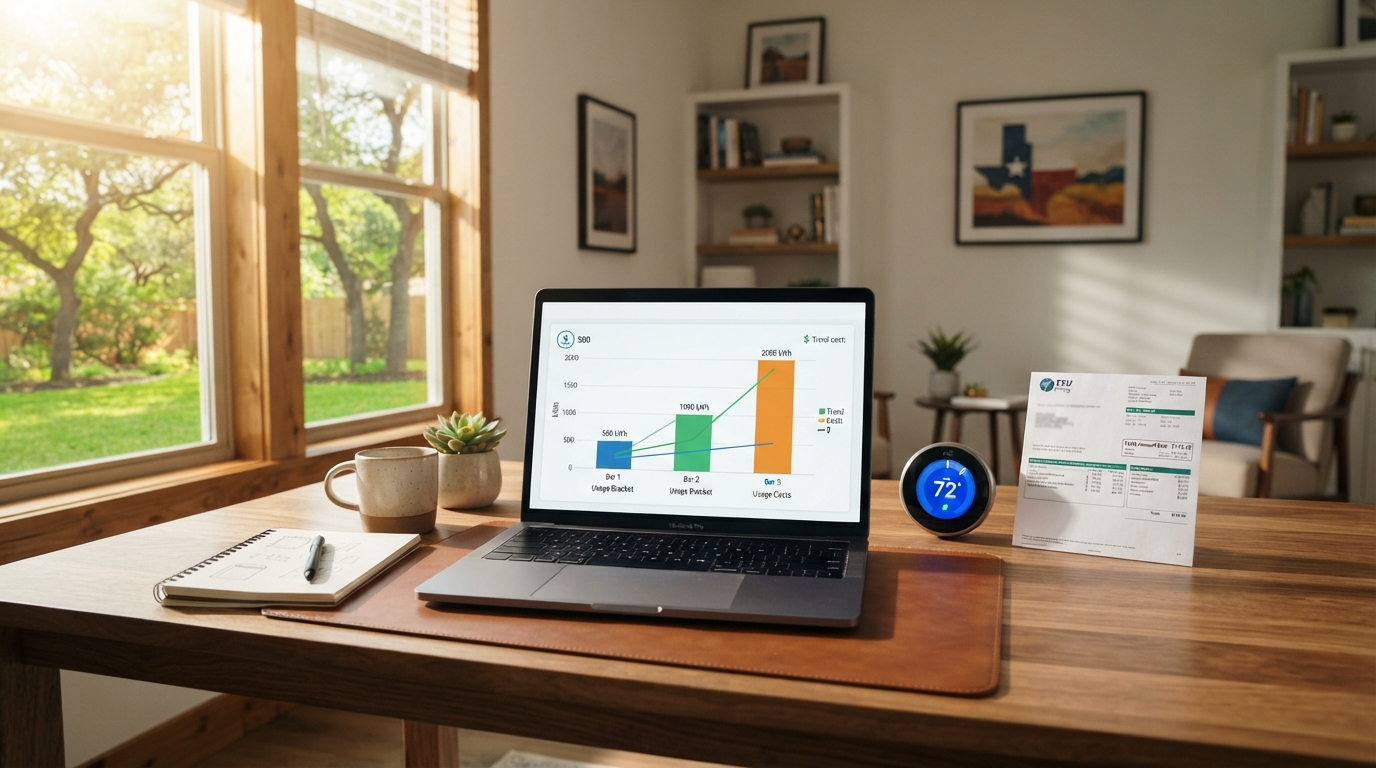
Imagine two next-door neighbors in Texas signing up with the exact same power company, choosing the exact same plan, and yet opening bills at the end of the month that feature wildly different average prices per kilowatt-hour (kWh). How is that possible? The secret lies in the often-misunderstood mechanics of tiered rate structures and usage brackets. Whether you are managing a household in electricity Houston style suburbs or a compact home out west offering electricity Fort Worth options, understanding how your power consumption aligns with your plan’s design is the single most important step in avoiding financial surprises.
As an expert guide and independent platform, BulbOne helps consumers explore their power to choose the best, most cost-effective, and reliable cheap electricity plans in Texas. However, navigating the Texas deregulated market requires looking past the bold headline numbers on a screen.
The Mystery of the 500, 1,000, and 2,000 kWh Brackets
When you browse standard comparison websites—keeping in mind that BulbOne is an independent resource and is in no way associated with PowerToChoose.org, which is operated by the PUC of Texas—you will notice that every advertised price per kWh is tied to a specific benchmark. Typically, these are calculated at standard usage blocks of 500 kWh, 1,000 kWh, and 2,000 kWh per month.
These benchmark figures include fixed and variable local charges, but the actual average price for electric service varies based on exact electricity usage patterns. If a plan looks remarkably inexpensive at the 2,000 kWh mark, it might carry a steep penalty or a drastically higher rate if your actual usage drops down to the 500 kWh bracket.
Why the Average Price Changes Drastically
Retail Electric Providers (REPs) frequently structure their pricing using tiers, base fees, and bill credits. A tiered rate structure means that the cost per kWh shifts depending on how much power you consume within a single billing cycle. For instance, a plan might feature a high base charge that gets absorbed easily when you use a large volume of electricity, making the per-kWh cost look very low. But if you use very little power, that same base fee is distributed across fewer kilowatt-hours, shooting your average price sky-high.
This dynamic also impacts commercial consumers exploring small business electricity providers, as well as residents looking into alternative account management structures like prepaid electric service. Because electricity service offers can be fixed or variable, rates are gathered directly from each provider’s Electricity Facts Label (EFL) for comparison purposes only. The EFL is your ultimate source of truth for uncovering hidden tier jumps.
How to compare Texas electricity rates Effectively
To outsmart the tiered rate trap, you need to know your historical usage. Don’t just guess your bracket—pull up your past 12 months of utility statements to find your true average. If your home consistently hovers around 900 kWh a month, shopping based on a 2,000 kWh EFL tier will lead to inaccurate expectations.
BulbOne helps users filter options transparently based on their unique usage profile, matching your actual habits against the official EFL documentation rather than surface-level advertising.
Confused about which usage bracket fits your home? Just call 1-844-567-2863 to speak with our Texas energy experts for personalized guidance.
Frequently Asked Questions
What happens if I use more electricity than my chosen bracket?
Depending on your EFL terms, exceeding your bracket might shift you into a higher-priced tier or trigger overage fees, though some flat-rate fixed plans charge a flat fee per kWh regardless of volume.
Are the prices shown on comparison sites guaranteed?
No, the displayed prices are examples based on exact usage blocks of 500, 1,000, or 2,000 kWh. Your actual average price depends entirely on your home’s unique consumption.
Where can I find the official details for a specific plan?
Every legally required detail, including tiered pricing thresholds and base fees, is explicitly detailed in the provider’s Electricity Facts Label (EFL).