
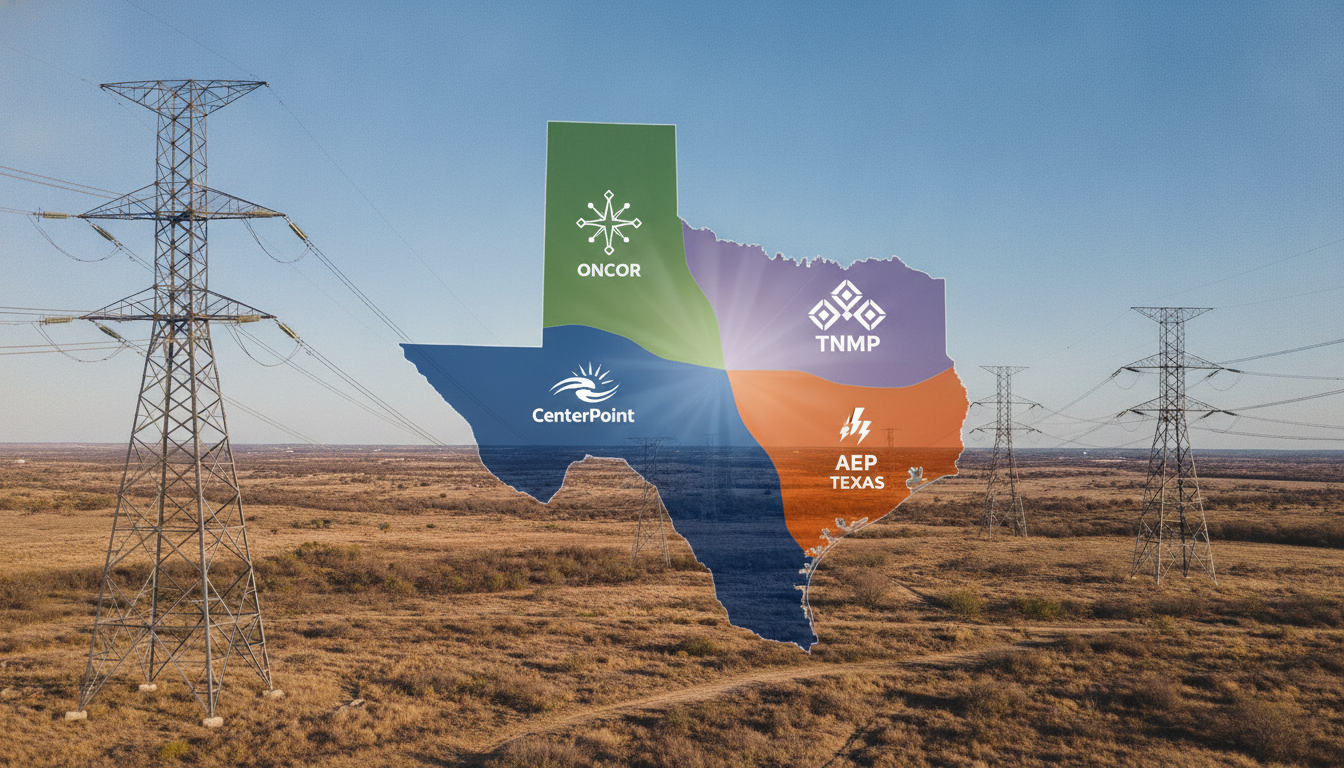
Your electricity options and rates in Texas are largely dictated by where you live. While you choose your retail electricity provider (REP), a crucial, often overlooked, layer exists: the Transmission and Distribution Service Providers (TDSPs) that actually deliver power to your home.
Think of Texas’s electricity market like a highway system. REPs are like car dealerships, offering various models and prices. But who maintains the roads? That’s the TDSP. These utility companies own and operate the poles, wires, meters, and infrastructure that physically bring electricity to your doorstep, ensuring grid maintenance, outage restoration, and reliable delivery.
The Four Pillars of Texas Power Delivery
Across the deregulated areas of Texas, four major TDSPs dominate the landscape, each serving a distinct geographic region:
Oncor Electric Delivery
As the largest TDSP, Oncor serves a massive chunk of North and Central Texas, including the Dallas-Fort Worth metroplex. If you live here, Oncor is your utility, regardless of your chosen REP.
CenterPoint Energy
CenterPoint primarily focuses on the Houston metropolitan area and surrounding Gulf Coast regions, ensuring power for millions in Southeast Texas.
AEP Texas (North and Central)
AEP operates in two zones: AEP North (Panhandle, Big Country) and AEP Central (South, West Texas, including Corpus Christi). Their expansive territory covers diverse communities.
Texas-New Mexico Power (TNMP)
While smaller, TNMP delivers electricity to distinct pockets across Texas, including parts of North Texas, the Gulf Coast, and western communities.
When you compare Texas electricity rates, remember the total price per kWh isn’t just the energy charge. It also includes fixed and variable local charges from your regional TDSP. These utility charges cover infrastructure maintenance and are consistent for every customer within that TDSP’s service area, regardless of their REP. This is why average prices per kWh, typically based on standard 1,000 kWh or 2,000 kWh monthly usage blocks, incorporate these essential delivery fees.
At BulbOne, we understand navigating these regional utility delivery zones and diverse electricity plans can feel complex. As an independent platform, we empower consumers to explore their power to choose the best, most cost-effective, and reliable cheap electricity plans in Texas. Remember, pricing is based on each specific area’s utility rates, and not all cities in Texas have electric choice – some are still regulated. Our platform gathers rates directly from each provider’s Electricity Facts Label (EFL) for comparison only. Electricity offers can be fixed or variable; rates are subject to change and only finalized upon agreement. We are an independent resource, not associated with PowerToChoose.org (operated by the PUC of Texas).
Understanding your TDSP is key to comprehending your electricity bill and service reliability. BulbOne helps you cut through Texas energy market complexities, ensuring you find the best local options tailored to your delivery zone. Want to check the most competitive rates available in your specific Texas zip code? Just call 1-844-567-2863 to speak with our local energy experts today.
What is a TDSP?
A TDSP (Transmission and Distribution Service Provider) is the utility company responsible for delivering electricity to your home, maintaining the power lines, poles, and meters, and restoring service during outages. They are separate from the company that sells you electricity.
How do TDSP charges affect my electricity bill?
TDSP charges are a component of your total electricity bill. These fixed and variable local charges are passed through by your retail electricity provider and cover the cost of maintaining the local grid infrastructure. They are the same for all customers within a specific TDSP’s service area, regardless of their chosen electricity plan.
Can I choose my TDSP?
No, you cannot choose your TDSP. Your TDSP is determined by your geographic location within Texas. Each area is served by a specific utility company like Oncor, CenterPoint, AEP Texas, or TNMP, which is assigned to that region.